Dlaczego warto to znać?
Z pozoru błaha kwestia, jaką są przyimki miejsca i czasu (prepositions of place oraz prepositions of time), może być jednym z główniejszych powodów nieporozumień w międzynarodowym zespole IT. Znajomość tego, kiedy używać in , on czy at , wpływa nie tylko na poprawność językową, ale również na precyzję przekazu. Błędnie użyty przyimek może sprawić, że twój e-mail o spotkaniu zostanie odebrany zupełnie inaczej, niż zamierzałeś.
W życiu zawodowym (np. in the office, at work) oraz prywatnym (at home, at the weekend) stosowanie przyimków to codzienność. Praktyka czyni mistrza , więc warto opanować te podstawy języka angielskiego, nawet jeśli na co dzień posługujesz się głównie kodem.
Czym są przyimki i jak ich używać?
Przyimki (ang. prepositions) to krótkie słowa, które łączą rzeczowniki (lub zaimki) z innymi częściami zdania, wskazując zależności przestrzenne, czasowe lub logiczne. W języku angielskim, w przeciwieństwie do języka polskiego, przyimki są nieodzowne i mają konkretne zastosowanie. Ich użycie rzadko wynika z intuicji, dlatego warto poznać zasady i przykłady, które pomogą je stosować poprawnie.
W przypadku przyimków in , on i at , mówimy o tzw. przyimkach miejsca (prepositions of place) i przyimkach czasu (prepositions of time).
Przyimki miejsca – prepositions of place
| Przyimek | Znaczenie | Przykład (ogólny) | Przykład (IT) |
|---|---|---|---|
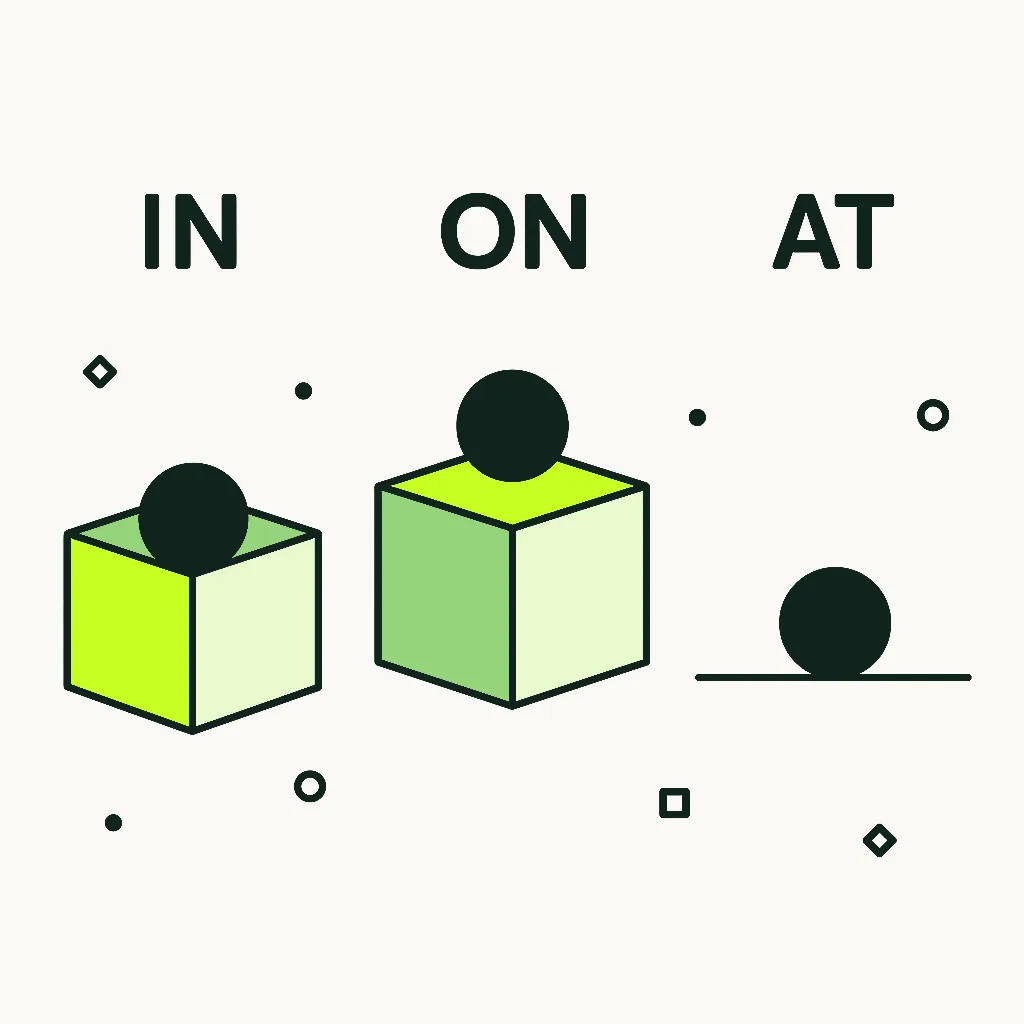
| in | wewnątrz, w środku, w obrębie | The keys are in the box. | The files are in the folder. |
| on | na powierzchni | The book is on the table. | The error message is on the screen. |
| at | w konkretnym miejscu/punkcie | She is at the door. | He is at the server room. |
Przyimki czasu – prepositions of time
| Przyimek | Kiedy używamy | Przykład |
|---|---|---|
| in | miesiące, lata, pora dnia, dłuższy okres | in July, in 2023, in the morning |
| on | konkretne dni, daty | on Monday, on 5th May, on Christmas Day |
| at | dokładna godzina, noc, weekendy, święta | at 5 PM, at night, at the weekend, at Christmas |
Jak zapamiętać?
Dla miejsca:
- in = wewnątrz czegoś (np. in the room , in the world , in the picture)
- on = na powierzchni (on the table , on the wall , on the floor)
- at = punkt (at the bus stop , at the concert , at home)
Dla czasu:
- in = dłuższy przedział czasu (in the morning , in the year , in winter)
- on = konkretne dni i daty (on Friday , on Christmas Day , on my birthday)
- at = dokładna godzina lub ogólna pora (at night , at the weekend , at midnight)
Pamiętaj, że niektóre przyimki mogą sprawiać trudność ze względu na ich użycie idiomatyczne. Na przykład w języku polskim mówimy „na zdjęciu”, ale po angielsku – in the picture. Również in the world może oznaczać „na świecie”, mimo że nie pasuje dosłownie.
Przykłady codzienne (spoza IT):
- She is at school , but her bag is in the car.
- We had a picnic on the grass , near the road.
- The concert was at the museum , and I sat on the left.
- At night , I usually listen to the radio.
- He was born in Poland , in the year 1990.
- The cat is under the table , near the corner.
- I like to drink coffee in the evening , especially at home.
- At Christmas , we meet at my grandmother’s house.
Przykłady z IT
IN – w zamkniętej przestrzeni, w obrębie czegoś, w danym czasie:
- In the office – „I’m working in the office today.”
- In the world – „The best developers in the world use this tool.”
- In the middle of the screen – „The error message appears in the middle.”
- In the picture – „Find the bug in the picture.”
- In the code – „There’s a typo in the function name.”
Czas:
- In the morning/afternoon/evening (ale: at night)
- In the week/month/year/winter
ON – na powierzchni, w dni tygodnia, konkretne daty:
- On the table – „The laptop is on the table.”
- On the wall – „Post the network diagram on the wall.”
- On the floor – „There’s a cable on the floor.”
- On the bus/train/plane – „He is coding on the train.”
Czas:
- On Monday / On Christmas Day / On Easter Sunday
- On my birthday
AT – punkt, konkretne miejsce lub moment:
- At work – „She is at work right now.”
- At home – „Developers usually work at home.”
- At the meeting – „We discussed it at the meeting.”
- At the concert/post office/museum
- At the weekend / At night / At midnight
Typowe błędy i jak ich unikać
1.In the office czy at the office?
Obie wersje poprawne, ale:
- In the office = fizycznie w środku budynku.
- At the office = ogólnie w pracy, niekoniecznie w budynku.
2.On the morning czy in the morning?
- Zawsze: in the morning.
- Wyjątek: on Monday morning.
3.On the weekend czy at the weekend?
- W brytyjskim angielskim: at the weekend.
- W amerykańskim: on the weekend.
4.At school czy in school?
- At school = jako uczeń/nauczyciel.
- In school = fizycznie w budynku.
5.In the bus czy on the bus?
- Zawsze: on the bus (wyjątek: in a taxi).
Sprawdź się!
- The developer is working ___ the office today.
- The cable is lying ___ the floor.
- We have a sprint review ___ Friday.
- The documentation is ___ the shared folder.
- He will be ___ home this weekend.
- Let’s meet ___ the corner near the cafe.
- The bug is ___ the log file.
- They arrived ___ the meeting just in time.
- I’m going to work ___ the bus.
- The config file is ___ the box.
Podsumowanie – Jak używać przyimków in, at, on w języku angielskim
W pracy specjalisty IT, przyimki pojawiają się wszędzie:
- At the desk , in the room , on the screen
- Meet at 3PM , the server is in the rack , on the dashboard , in the log file
- She is at the keyboard , we met at the corner of the building
Pamiętaj, że precyzyjna komunikacja techniczna wymaga poprawnego używania przyimków, zwłaszcza w dokumentacji, zgłoszeniach bugów, czy rozmowach na stand-upach.
Znajomość przyimków in , on , at to podstawa, która wpływa na komunikację w zespole IT. Przyimki miejsca i czasu pojawiają się w każdym aspekcie zawodowego życia: od opisu buga po planowanie deploya.
Pamiętaj, że:
- In = w czymś (zamknięta przestrzeń, dłuższe okresy czasu)
- On = na czymś (powierzchnia, konkretna data)
- At = punkt (miejsce lub moment)
Jeśli chcesz poprawnie używać przyimków w języku angielskim, skup się na kontekście i zwracaj uwagę na typowe wyjątki. Zajrzyj do dokumentacji, porównaj przykłady, a z czasem będzie to dla Ciebie naturalne.